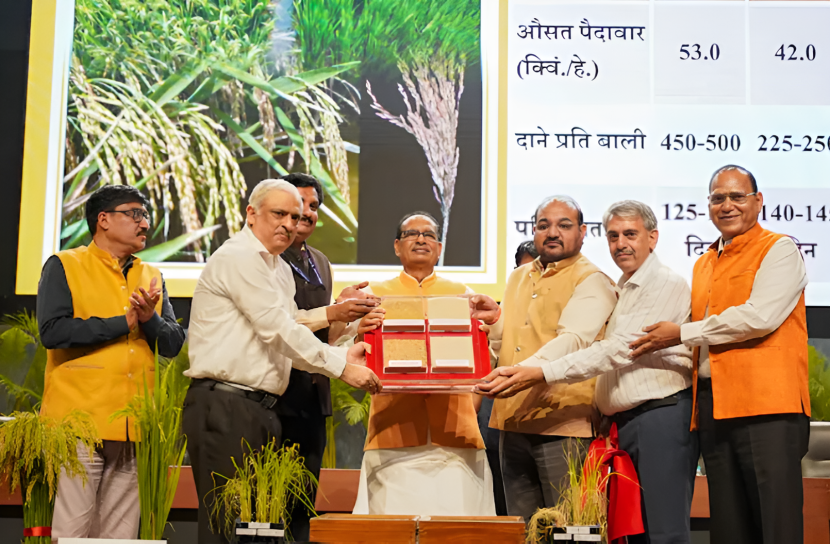
India has achieved a significant milestone in agricultural biotechnology by becoming the first country to develop and release genome-edited rice varieties. On May 4, 2025, Agriculture Minister Shivraj Singh Chouhan unveiled two new rice varieties—DRR Dhan 100 (Kamala) and Pusa DST Rice 1—developed by the Indian Council of Agricultural Research (ICAR) using cutting-edge genome editing techniques.
Understanding Genome Editing in Agriculture
Genome editing is a modern scientific technique used to make precise, targeted changes to the DNA of living organisms, including plants, animals, and even humans. Think of it like using a pair of molecular scissors to cut, delete, or modify specific genes to improve traits or remove undesirable ones.
Unlike traditional genetic modification (GMOs), genome editing does not usually involve adding foreign DNA from another species. Instead, it modifies the organism’s existing DNA, often making the change indistinguishable from a natural mutation.
For example, by targeting specific genes, such as the ones responsible for fruit softening and disease susceptibility, researchers have developed tomato varieties that stay fresh longer, resist common fungal infections like powdery mildew, and even produce more vitamin D. These modifications help reduce food waste, decrease the need for chemical pesticides, and offer added nutritional value—all without introducing any foreign DNA. As a result, genome-edited tomatoes represent a sustainable and consumer-friendly advancement in agricultural science.
Differentiating Genome Editing from Genetic Modification
While genome editing and genetic modification may sound similar, they are fundamentally different in how they alter an organism’s DNA.
- Genome Editing (GE): Involves precise alterations to existing genes without introducing foreign DNA.
- Genetic Modification (GM): Typically involves inserting genes from other species, which can raise regulatory and public acceptance challenges.
Introducing the New Rice Varieties
1. DRR Dhan 100 (Kamala)
- Developed by: ICAR-Indian Institute of Rice Research (ICAR-IIRR), Hyderabad
- Parent Variety: Samba Mahsuri (BPT 5204)
- Key Enhancements:
- Targeted the Cytokinin Oxidase 2 (CKX2) gene to increase grain numbers per panicle
- Achieved a 19% yield improvement over its parent variety
- Demonstrated superior drought tolerance and high nitrogen-use efficiency
- Matures approximately 20 days earlier than Samba Mahsuri
- Retains the grain and cooking quality preferred by consumers
2. Pusa DST Rice 1
- Developed by: ICAR-Indian Agricultural Research Institute (ICAR-IARI), New Delhi
- Parent Variety: MTU1010
- Key Enhancements:
- Targeted the Drought and Salt Tolerance (DST) gene to improve resilience to harsh soil and climate conditions
- Enhanced drought and salinity tolerance without compromising existing strengths
- Maintains the fine-grain quality of MTU1010
Significance for Indian Agriculture
Rice is a staple food for a significant portion of India’s population, and improving its resilience and yield is crucial for food security. The development of these genome-edited varieties offers several benefits:
- Climate Resilience: Enhanced tolerance to drought and salinity helps ensure stable production amid changing climate conditions.
- Resource Efficiency: Improved nitrogen-use efficiency and reduced water requirements contribute to sustainable farming practices.
- Higher Yields: Increased grain numbers per panicle lead to better productivity, benefiting farmers economically.
- Consumer Acceptance: Maintaining the grain quality of popular varieties like Samba Mahsuri and MTU1010 ensures consumer preferences are met.
Future Implications
The release of India’s first genome-edited rice varieties marks a transformative moment in agricultural science—not just for the country but for the world. By harnessing the precision of genome editing, India is setting a new standard in developing high-yield, climate-resilient, and sustainable crops without the controversies often associated with GMOs.
These innovations reflect the power of science in addressing global challenges like food security, climate change, and nutritional deficiencies. As more such advancements unfold, genome editing will likely become a cornerstone of next-generation farming—smart, efficient, and tailored for a better tomorrow.
India’s pioneering step with DRR Dhan 100 and Pusa DST Rice 1 shows that with vision, research, and responsible innovation, the future of agriculture can be both productive and sustainable.